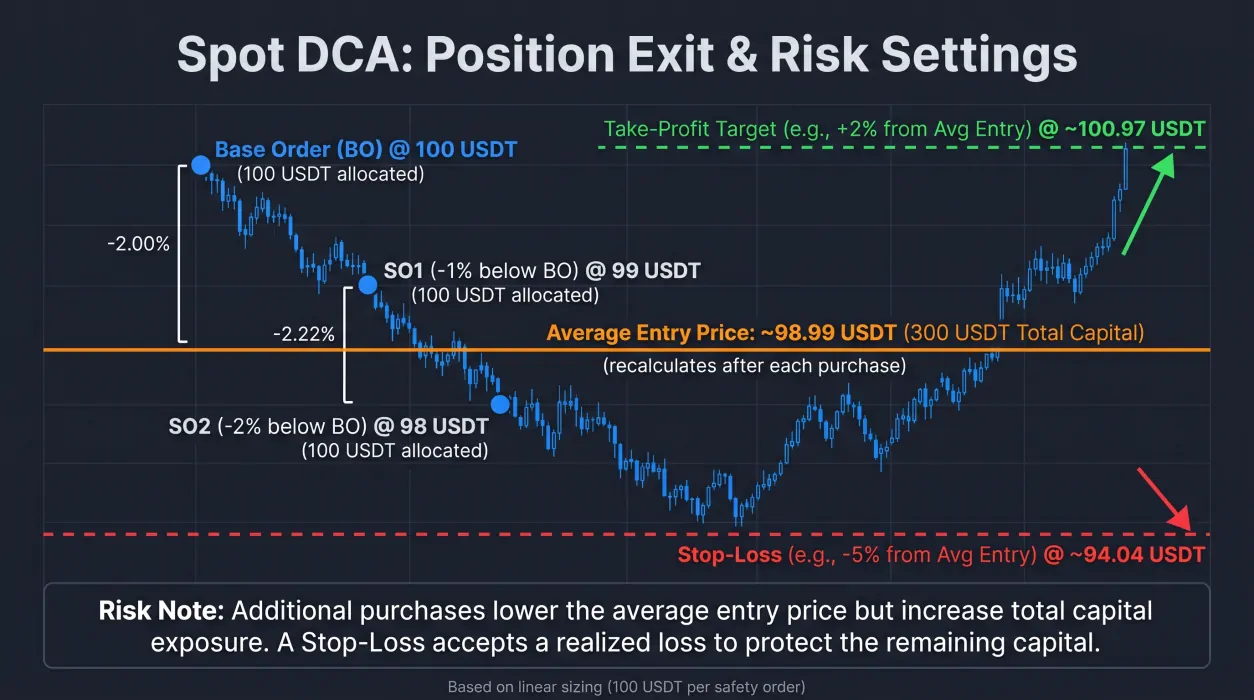
A Spot DCA bot needs an exit plan as carefully as it needs an entry plan. Take-profit settings determine when the bot closes a position after price moves favorably, while stop-loss settings define how it responds when the trade moves against it.
Prime Trading Bot’s Spot DCA supports static and dynamic take-profit options, including trailing behavior, as well as static and dynamic stop-loss options. The right configuration depends on your entry rules, Safety Order plan, and the amount of downside exposure you are prepared to accept.
For a broader strategy comparison, see Spot DCA vs. Spot Grid.
How Spot DCA exits work
A Spot DCA strategy starts with a Base Order (BO) and can add Safety Orders (SOs) when price moves below the original Base Order price. The bot then manages the position according to its configured exit rules.
A simplified cycle looks like this:
- The bot opens a position with a Base Order.
- If price declines and the configured conditions are met, the bot may place Safety Orders.
- The position’s average entry price changes as additional orders fill.
- A take-profit or stop-loss condition may trigger an exit.
- The bot closes the position according to the configured exit behavior.
An important detail: Safety Orders are triggered at percentages below the original Base Order price, not below a continuously recalculated average entry price.
Static take-profit
A static take-profit uses a fixed target relative to the position’s average entry price.
When the target condition is reached, the bot attempts to close the position according to its configured take-profit behavior.
When static take-profit may fit
A fixed target can be useful when you want a consistent exit rule across trades and do not want the target to change as price moves.
Consider:
- How far price typically moves during the market conditions you trade.
- Whether the target leaves enough room to account for trading fees.
- Whether Safety Orders may change the average entry price before the exit.
- Whether the target is compatible with your intended holding period.
A static target does not guarantee that an order will execute at the exact target price. Market conditions, liquidity, and order execution can affect the realized exit.
Dynamic take-profit
A dynamic take-profit adjusts its behavior based on the position or market movement rather than relying only on one fixed target.
Prime Trading Bot supports dynamic take-profit options. The exact behavior depends on the selected configuration, so review the corresponding setting in the Spot DCA user guide before enabling it.
DCA trailing take profit
A DCA trailing take profit can follow favorable price movement before triggering an exit. This changes the trade-off between closing at a predefined target and allowing a position to remain open while price continues moving favorably.
A trailing exit can also trigger after a reversal. It does not guarantee that the bot will capture the highest price reached during a trade.
Dynamic TP/SL and market volatility
When a dynamic TP/SL uses ATR or another volatility-based measure, its distance from the current price can automatically expand or contract as market volatility changes. For example, during sharp price swings, a wider TP/SL band may help reduce the chance of triggering an exit too early; during quieter conditions, the band may become narrower.
This is a general description of volatility-based exit logic. The exact formula and behavior depend on the specific implementation and settings.
Dynamic versus static take-profit
| Setting | General behavior | Main consideration |
|---|---|---|
| Static take-profit | Uses a fixed target | The target may close the position before a stronger move continues |
| Dynamic take-profit | Adjusts the exit behavior according to its configured rules | The exit rule may be more complex to evaluate and backtest |
| Trailing take-profit | Can follow favorable price movement before triggering an exit | A reversal can trigger an exit after price has moved away from its peak |
Dynamic exits are not automatically better than static exits. They change the trade-off between having a predefined target and allowing the exit to respond to price movement.
Static stop-loss
A static stop-loss defines a fixed loss threshold for the position.
When the configured condition is reached, the bot can exit the position rather than continuing to hold it in anticipation of a recovery.
Why a stop-loss matters in DCA
DCA strategies can add Safety Orders as price declines. That can lower the average entry price, but it also increases the amount of base asset held.
Without a clear exit plan, a position may continue accumulating exposure during a sustained decline. A stop-loss can define a point where the strategy stops treating the move as a temporary pullback.
Before setting a static stop-loss, consider:
- Whether the stop is compatible with the spacing of your Safety Orders.
- Whether a normal price fluctuation could trigger it prematurely.
- Whether your total position size remains acceptable if several Safety Orders fill.
- Whether you have tested the rule against different market conditions.
A stop-loss does not eliminate execution risk. A fast market can move through the trigger level, and the final execution price may differ from the expected price.
Dynamic stop-loss
A dynamic stop-loss changes its behavior according to its configured rules rather than using only one fixed threshold.
A dynamic ATR stop loss is a common trading concept in which a stop level is adjusted using Average True Range (ATR), a volatility measure. However, do not assume a particular ATR formula or setting is available in Prime Trading Bot unless it is confirmed in the product documentation.
When a dynamic stop-loss is volatility-based, its distance can widen during more volatile conditions and narrow when volatility decreases. This can help the stop adapt to changing market conditions, but it does not eliminate the risk of a losing trade or guarantee better execution.
Dynamic stops can make an exit respond differently as a position develops, but they also make the strategy more dependent on the precise configuration.
Do not assume that a dynamic stop will always reduce losses compared with a static stop. Its behavior should be evaluated using the same entry rules, Safety Order settings, and market data as the rest of the strategy.
How Safety Orders affect exit planning
Safety Orders are an important part of DCA risk management because they change both the position size and the average entry price.
In Prime Trading Bot:
- Safety Orders trigger at configured percentages below the original Base Order price.
- Safety Order sizing is linear rather than martingale-based.
- The default maximum is two Safety Orders.
- Each Safety Order uses the same scale.
- At least 60 seconds must have passed since the previous buy.
- If enabled, the RSI filter can affect whether a Safety Order is placed.
- Safety Orders become permanently locked after any take-profit tier fires.
The final point matters when planning exits. Once a take-profit tier has fired, the bot does not resume adding Safety Orders to that position.
For a detailed setup walkthrough, see How to Configure Spot DCA Safety Orders. For more on entry conditions and Safety Order behavior, see How the Spot DCA bot works and Spot DCA trading strategies.
Crypto DCA breakeven price
The crypto DCA breakeven price is the price at which the position’s value equals its total cost, before or after accounting for fees depending on how it is calculated.
When Safety Orders fill at lower prices, the average entry price can decrease. But a lower average entry price does not automatically mean the position is less risky: the total amount invested and base asset held may also increase.
For exit planning, distinguish between:
- Average entry price: the average purchase price of the accumulated base asset.
- Breakeven price: the price required to recover the position’s cost under the chosen fee assumptions.
- Take-profit target: the configured exit condition, which may be above breakeven.
- Stop-loss level: the configured condition for exiting when the trade moves adversely.
Backtest the complete exit plan
Testing only the take-profit or stop-loss setting in isolation can miss important interactions. The entry rules, Safety Order spacing, position size, and exit conditions all affect the result.
Prime Trading Bot’s DCA backtest uses Binance candle data and deducts 0.1% per order. It is a simplified simulation and does not account for every real-world execution issue, such as missed opportunities caused by latency.
Use backtesting to compare configurations, not as a forecast of future results.
A useful comparison keeps the entry strategy consistent while changing one exit setting at a time:
| Test | Keep consistent | Change |
|---|---|---|
| Static TP comparison | Entry indicators, BO, SO settings | Static take-profit target |
| Dynamic TP comparison | Entry indicators, BO, SO settings | Dynamic take-profit configuration |
| Stop-loss comparison | Entry indicators, BO, SO settings, TP | Static versus dynamic stop-loss |
| Combined exit test | Same market data and entry rules | Final TP and SL combination |
Practical exit-setting checklist
Before running a Spot DCA strategy, review the following:
- [ ] Base Order entry conditions are clearly defined.
- [ ] Safety Order triggers are understood relative to the original BO price.
- [ ] Maximum Safety Order count and sizing fit the intended exposure.
- [ ] Take-profit behavior is understood for both static and dynamic settings.
- [ ] Stop-loss behavior is understood for both static and dynamic settings.
- [ ] The interaction between take-profit tiers and Safety Order locking is understood.
- [ ] Trading fees are included when evaluating exit targets.
- [ ] The complete configuration has been backtested.
- [ ] API permissions are restricted to Spot trading, with withdrawals disabled.
For installation and configuration instructions, see the Spot DCA guide or the Spot DCA product page.
FAQ
Is static or dynamic take-profit better for Spot DCA?
Neither is universally better. Static take-profit uses a fixed target, while dynamic take-profit changes its behavior according to the selected rules. Compare both with the same entry and Safety Order configuration.
Can Safety Orders continue after a take-profit tier fires?
No. In Prime Trading Bot, Safety Orders become permanently locked after any take-profit tier fires.
Does a stop-loss guarantee the exit price?
No. A stop-loss defines an exit condition, but fast price movement, liquidity, and order execution can affect the final fill price.
Should I use a stop-loss with a DCA bot?
That depends on the strategy and the amount of exposure you are willing to accept. DCA can add Safety Orders during declines, so exit rules should be planned alongside maximum order count and position sizing.
Can I rely on backtesting to predict live results?
No. The DCA backtest uses Binance candle data and deducts 0.1% per order, but it is a simplified simulation. It can help compare configurations, not predict future performance.
Key takeaways
- Spot DCA exit rules should be planned together with Base Order and Safety Order settings.
- Static take-profit uses a fixed target; dynamic take-profit adjusts according to its configured behavior.
- DCA trailing take profit can follow favorable price movement, but reversals can trigger an exit.
- Volatility-based dynamic TP/SL distances can expand or contract as market conditions change; verify the exact product implementation before describing it as a bot feature.
- Safety Orders are locked after any take-profit tier fires.
- Backtest the complete strategy and treat results as comparisons, not forecasts.