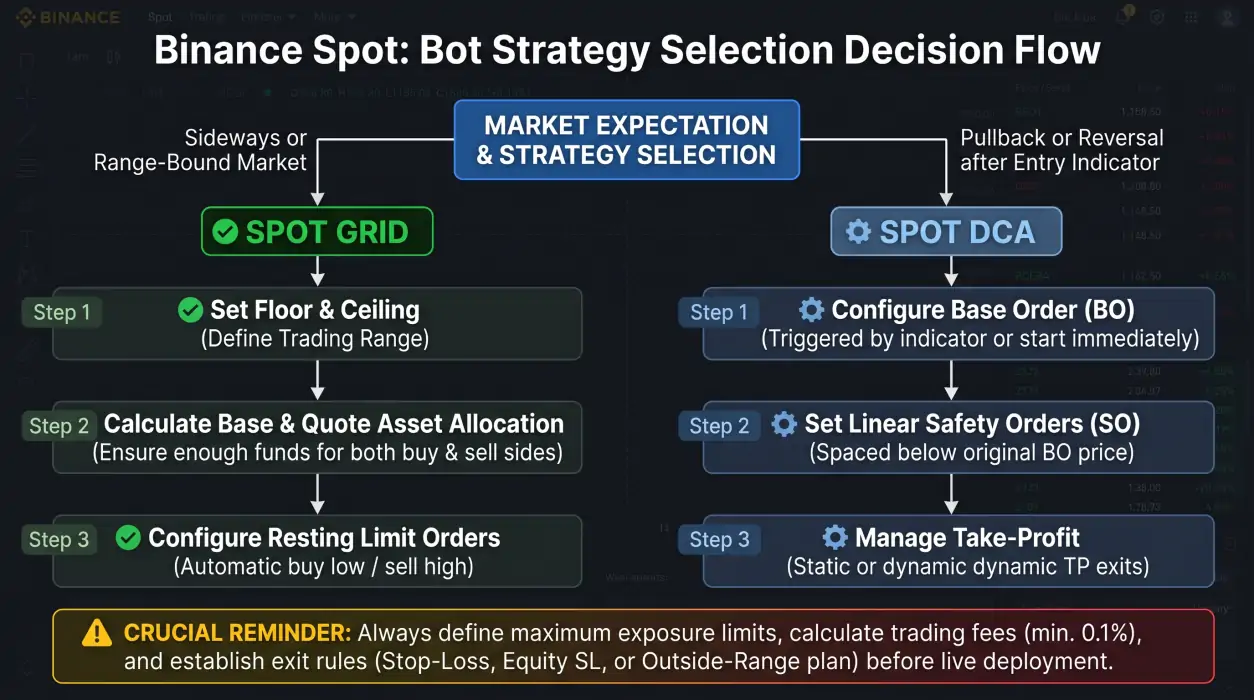
Choosing a Binance spot trading bot strategy starts with understanding how the strategy behaves in different market conditions—not with searching for a setup that works everywhere. Spot DCA and Spot Grid can automate different trading approaches, but both require clear rules for capital allocation, market exposure, and what happens when price moves outside the expected range.
This guide compares the two approaches and outlines practical questions to answer before configuring a bot.
Start with the strategy’s trading logic
A bot’s name matters less than the orders it places and the conditions that trigger them.
| Strategy | Core logic | Typical objective | Main consideration |
|---|---|---|---|
| Spot DCA | Places a Base Order, then may add Safety Orders as price moves down | Build a position and manage its exit through take-profit or stop-loss rules | Additional buys increase exposure during a decline |
| Spot Grid | Places buy and sell limit orders at fixed price intervals | Capture repeated price movements within a defined range | Price can leave the range, leaving the bot holding assets or quote currency |
A Spot DCA setup is organized around a position cycle. A Spot Grid setup is organized around a price range and a sequence of orders.
For a deeper comparison, see Spot DCA vs Spot Grid on Binance.
Match the strategy to market conditions
Market conditions can change while a bot is running. A strategy should therefore be evaluated not only by its intended trading environment, but also by how it behaves when that environment changes.
Sideways or range-bound markets
A market that repeatedly moves between support and resistance may provide conditions for a Spot Grid strategy. The bot places orders at predefined levels, and completed buys or sells can create new orders one grid step away.
The main challenge is defining a range that is wide enough to accommodate price movement without making the grid so sparse that its order spacing becomes impractical.
Grid configuration also matters. Arithmetic grids use equal absolute price intervals, while geometric grids use equal percentage intervals. If the upper and lower boundaries differ substantially, a geometric grid may provide more consistent percentage spacing.
See How to Configure a Binance Spot Grid Bot for the configuration details.
Declining or volatile markets
Spot DCA may be considered when a trader wants to build a position through predefined entries rather than placing the entire intended allocation at once.
A Base Order can be subject to indicator conditions. Safety Orders can be configured to trigger at percentage levels below the original Base Order price. However, adding orders during a decline increases the amount of the asset held and does not guarantee that price will recover.
Before enabling Safety Orders, decide:
- How many additional orders the strategy may place
- How much capital each order requires
- Whether entry indicators should be enabled
- What take-profit or stop-loss conditions will end the cycle
For a detailed setup walkthrough, see How to Configure Spot DCA Safety Orders on Binance.
Strong, continuous up-trends
In a strong, sustained up-trend—especially a parabolic bull run—both strategies can experience opportunity cost compared with simply holding the asset.
A Spot Grid may keep quote currency, such as USDT, available for future Buy Limit orders. If price continues rising without returning to those levels, some of that capital may remain uninvested while the asset appreciates.
Spot DCA can face a similar trade-off when capital is reserved for Safety Orders that only trigger after price declines. If the market keeps rising, those orders may never execute, and the strategy may hold a smaller position than a Buy & Hold approach.
This does not mean Buy & Hold is always preferable. It highlights a different exposure profile: automated strategies may trade around price movements or follow predefined entry rules, while Buy & Hold maintains exposure to the asset. Compare the strategies based on the market scenario, capital deployment, and downside plan—not only on how they perform in a sideways market.
Decide what happens outside the expected range
A strategy is incomplete until its behavior outside the expected market conditions is defined.
Spot Grid: price moves below the floor
With a conventional grid, a move below the lower boundary can leave the bot holding the base asset while lower buy levels remain inactive. If price continues falling, the position may remain unrealized at a loss until price returns—or until the trader intervenes.
Possible controls include:
- Stop-loss or equity-based exit: Define a condition for stopping the grid and exiting the position.
- Trailing Down: Shift the grid lower as price moves down. This requires additional quote asset to continue placing lower Buy Limit orders; insufficient USDT may cause an error or stop new buys.
- DCA Safety Net: Add purchases below the grid floor, which can increase exposure and risk.
- Manual intervention: Pause the bot and reassess the range and market conditions.
For the detailed decision process, see How to Manage Spot Grid Orders Outside the Range.
Spot Grid: price moves above the ceiling
When price moves above the upper boundary, a conventional grid may stop placing new orders within its configured range. The bot may hold quote currency after selling assets at grid levels, limiting its participation in a continued rise.
A Sliding Grid or Trailing Up feature may help adjust the range after an upward move, but the trader should understand how the bot shifts its orders and what happens to existing inventory.
Spot DCA: price continues declining
A DCA cycle can accumulate more base asset as Safety Orders trigger. That makes it important to define a maximum number of orders and a maximum allocation before starting.
Do not treat a larger number of Safety Orders as a substitute for a risk limit. More orders can change the average entry price, but they also require more capital and increase exposure if the decline continues.
Build risk controls before enabling automation
A practical strategy plan should define its limits before the bot places its first order.
| Control | Question to answer |
|---|---|
| Capital allocation | How much capital can this pair use? |
| Entry conditions | Should the bot enter immediately or wait for indicators? |
| Maximum exposure | What is the maximum amount the bot may commit? |
| Exit rules | What condition closes or stops the trading cycle? |
| Out-of-range behavior | What happens if price leaves the expected range? |
| Monitoring | How often will you review orders, balances, and bot status? |
For Spot DCA, review Base Order size, Safety Order count and size, take-profit logic, and stop-loss settings. For Spot Grid, review the price range, grid count, grid type, order size, and any range-shifting or exit controls.
Backtesting can help compare configurations against historical candles, but it is not a forecast. Simulations may simplify execution and cannot fully reproduce latency, missed fills, or future market conditions.
Check the operational setup
Strategy selection is only one part of running a trading bot. The technical setup also affects reliability and account security.
Before connecting a bot:
- Confirm that the software supports the exchange and market you intend to trade.
- Create an API key with Spot Trading permission only.
- Keep withdrawal permission disabled.
- Consider IP restrictions where supported.
- Store API credentials securely on the machine or server running the bot.
- Test the configuration before committing live capital.
- Monitor order placement, balances, and errors after deployment.
Prime Trading Bot is self-hosted Binance Spot software. The bot runs on a Windows or Linux server, while its GUI can run on a local PC. It does not provide custody, investment services, or financial advice.
See the Spot DCA user guide and Spot Grid user guide for installation and operation details.
Frequently asked questions
Is Spot DCA better than Spot Grid?
Neither is universally better. Spot DCA manages a position through predefined entries and exits, while Spot Grid places orders across a price range. The appropriate choice depends on the market scenario, capital allocation, and the trader’s risk controls.
Can a Spot Grid bot perform well in a strong bull market?
A conventional grid may sell assets at successive levels and hold quote currency while price continues rising. That can create opportunity cost compared with Buy & Hold. Range-shifting features may change this behavior, but they do not eliminate market risk.
Should I use more Safety Orders to reduce risk?
Not automatically. More Safety Orders can spread entries across a larger decline, but they also require more capital and can increase total exposure. Set the maximum allocation first, then configure the order count and size within that limit.
Is backtesting enough to choose a strategy?
No. Backtesting can help compare historical behavior, but results depend on assumptions and do not guarantee future outcomes. Combine it with a clear risk plan and careful live monitoring.
Key takeaways
- Choose a strategy based on its order logic and the market conditions it is designed to handle.
- Spot DCA and Spot Grid have different exposure profiles and can both experience opportunity cost in a strong, continuous up-trend.
- Define capital limits, exits, and out-of-range behavior before starting a bot.
- Treat backtests as historical comparisons, not forecasts.
- Review API permissions, deployment, and monitoring as part of the trading plan.